Table BCraps & Dice
How to Play Craps
- 4 min
- pg. 19
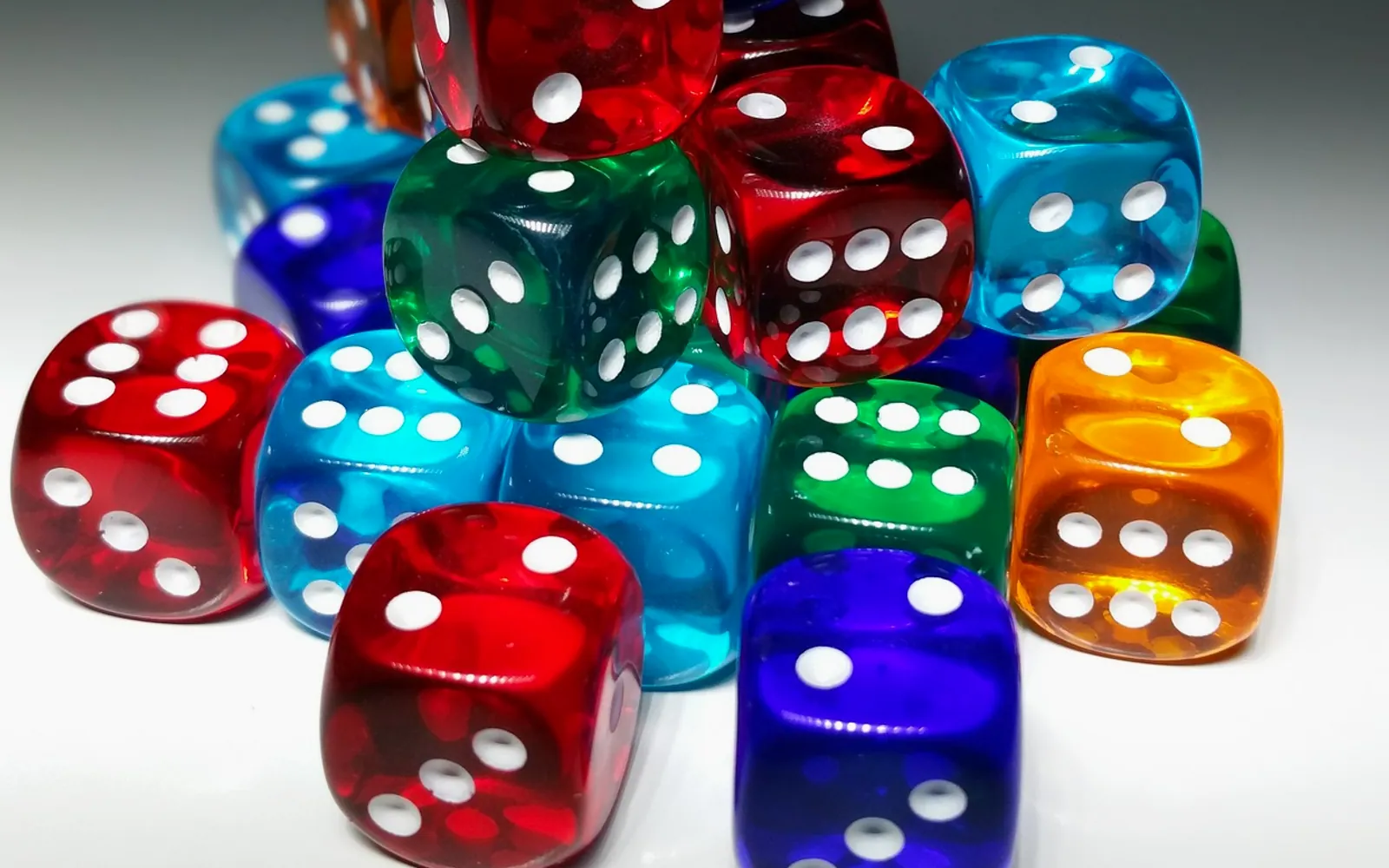
A craps table can look like the loudest corner of a casino, with chips stacked in a dozen boxes and numbers called faster than a newcomer can follow. Underneath the noise sits a plain game: two dice, one shooter and a round with only two phases. This guide is meant for adult readers, 18 or older, who would like to know the game before any money touches the felt.
The dice come first
Everything in craps follows from two six-sided dice. Together they can land in 36 equally likely combinations, but the totals are not equally likely. There is only one way to roll a 2 and six ways to roll a 7, which is why 7 plays such a central role.
| Total | Ways to roll it | Chance per roll |
|---|---|---|
| 2 or 12 | 1 each | 1 in 36 |
| 3 or 11 | 2 each | 2 in 36 |
| 4 or 10 | 3 each | 3 in 36 |
| 5 or 9 | 4 each | 4 in 36 |
| 6 or 8 | 5 each | 5 in 36 |
| 7 | 6 | 6 in 36 |
Every payout at the table can be checked against these numbers, and that check shows which bets are cheap and which are expensive.
Who does what at the table
- The shooter throws the dice. The role passes around the table, and nobody has to take it.
- The stickperson moves the dice, calls each result and runs the centre bets.
- The dealers take bets, pay winners and collect losing chips; the boxperson supervises.
Online versions keep the same rules; software or a studio dealer does these jobs.
Phase one: the come-out roll
A round starts with the come-out roll. Most players begin with the pass line, the long strip that runs around the edge of the table. On the come-out:
- A 7 or 11 is a natural, and pass line bets win even money.
- A 2, 3 or 12 is craps, and pass line bets lose.
- Any other total (4, 5, 6, 8, 9 or 10) becomes the point. A dealer places a marker puck on that number and the round moves on.
Phase two: chasing the point
With the puck on a number, the same shooter rolls again and again. Only two results matter for the pass line now. If the point number appears again before a 7, pass bets win even money. If a 7 arrives first, the shooter "sevens out", pass bets lose and the dice move to the next player. Every other total in between is ignored for the pass line, although it may settle other bets on the layout.
Notice the shift. On the come-out, 7 is the pass bettor's friend. After a point is set, 7 is the number that ends the round against them.
Don't pass: betting with the house
The don't pass bar is the mirror image. It wins on a come-out 2 or 3, loses on a 7 or 11, and usually treats 12 as a tie (a push) so the casino keeps its small advantage. After a point is set, don't pass wins if a 7 comes before the point.
The small gap the casino lives on
Work through the dice table and you find that a pass line bet wins 244 times for every 251 losses over all possible rounds. That small gap is the house edge, roughly 1.41% of each pass line bet over the long run. Don't pass, with its barred 12, comes out slightly lower at about 1.36%. Neither figure is a promise about tonight; it is simply what the rules keep on average.
The odds bet: the quiet best buy
After a point is set, a pass bettor can add an odds bet behind the original chips. It pays at true odds: 2 to 1 on a point of 4 or 10, 3 to 2 on 5 or 9, and 6 to 5 on 6 or 8. Because those payouts match the real chances in the dice table, the odds bet itself carries no house edge. The casino caps how much you may add. It lowers the average cost per unit staked, but more money on the table never turns the game in your favour.
The middle of the table costs more
The centre of the layout holds one-roll and proposition bets with large printed payouts. Check them against the dice table. "Any seven" pays 4 to 1, yet the true odds against a 7 are 5 to 1, so the house keeps about one sixth of every such bet. Place bets on 6 or 8 pay 7 to 6 against true odds of 6 to 5, a far gentler cost of about 1.5%. The pattern holds across the table: the bigger and more exciting the payout, the larger the slice the house takes.
A simple first session
- Watch a few rounds before buying in, so the rhythm feels familiar.
- Choose a table minimum that fits the amount you set aside for the evening.
- Start with the pass or don't pass line only.
- If you want more action, add the odds bet rather than the centre bets.
- Stop when your set amount or your set time is used up, whichever comes first.
Craps is a game of independent rolls: hot streaks, cold dice and "due" numbers are stories, not patterns. If you also play wheel games, our guide on how to play roulette walks through that table the same way. Treat the money you bring as the price of an evening out, never as a way to earn, and if keeping to your limits gets hard, our thoughts on balancing fun with caution are a good place to pause.
Found a payout that looks off?
Tell us which sentence, and we will recheck it against the rules.